If you walked onto a manufacturing trade show floor in 2026, you would see something fundamentally different from just a few years ago. The machines are still cutting metal — but how they decide what to cut, how to cut it, and when to stop has changed dramatically.
The five‑axis machining center is no longer a niche capability reserved for aerospace primes and elite job shops. In 2026, it is becoming the new normal. Industry reports indicate that five‑axis machines will account for over 35% of new CNC lathe and machining center purchases, and the global market for 5‑axis CNC machine tools is projected to grow at a compound annual rate exceeding 10%.
But the real story is not just about more five‑axis machines — it is about smarter ones. This article breaks down the four defining trends of 2026: AI‑driven intelligence, lights‑out automation, hybrid manufacturing, and the democratization of five‑axis technology.
If there is one headline from 2026, it is this: artificial intelligence has stopped being a concept and has become a standard feature. At major exhibitions like CCMT2026, AI was no longer a showcase gimmick — it was integrated into the control systems of virtually every mainstream five‑axis machining center.
| Traditional CNC (Pre‑2025) | AI‑Enabled CNC (2026) |
|---|---|
| Operator manually adjusts feeds and speeds | System optimizes cutting parameters in real time |
| Collision avoidance programmed offline | AI-powered collision avoidance detects risks during operation |
| Thermal errors corrected after they occur | AI-driven thermal error compensation actively predicts and corrects drift |
| CAM programming requires experienced engineers to manually adjust the toolpath | AI-generated workflows automatically generate optimal toolpaths |
The most significant shift is that AI is now embedded directly into the CNC control — the “brain” of the machine. This means the machine can identify the part, generate the machining program automatically, and continuously optimize cutting parameters to maintain precision without constant human intervention. According to a 2026 report by the China Machine Tool & Tool Builders' Association, this transition marks a fundamental move from the “CNC era” to the “intelligent era” in manufacturing.
What this means for you: An AI‑equipped five‑axis machining center does not just follow instructions — it learns, adapts, and protects itself. For shops that struggle with skilled labor shortages or inconsistent part quality, this capability can be a game‑changer.
To see how these intelligent features are implemented across different machining center architectures, explore the CNC machining center lineup from EUMASEIKI.
In 2026, the question is no longer whether to automate, but how far. Five‑axis machining centers are increasingly equipped with features that enable extended unattended operation — sometimes running through entire nights and weekends with minimal human oversight.
Built‑in pallet changers allow multiple workpieces to be queued for machining, reducing downtime between cycles.
IoT connectivity enables predictive maintenance — the machine alerts you before a component fails, rather than after.
Robotic part handling is being integrated directly with machining centers, with industrial robots loading and unloading parts while the machine continues cutting.
Automated tool setters and probes eliminate manual touch‑off errors and enable in‑process measurement, automatically compensating for tool wear.
The industry is moving toward what some call the “lights‑out” factory — a production environment where machines can run unattended through the night, with lights off and no operators present. This is not science fiction; it is increasingly the competitive standard for high‑volume precision manufacturing.
What this means for you: Automation does not just reduce labor costs — it increases predictability. A machine that runs consistently through the night produces parts with consistent quality, fewer inspection surprises, and shorter lead times.
One of the most significant shifts in 2026 is the convergence of additive and subtractive manufacturing. The machining center is no longer viewed as a standalone metal‑cutting device, but as part of an integrated manufacturing ecosystem.
Additive‑subtractive hybrid machines combine 3D printing with traditional milling in a single platform. A part can be built up layer‑by‑layer, then finish‑machined to final tolerances without ever leaving the machine.
Digital twins — virtual replicas of the physical machine and workpiece — are being used to simulate and optimize the entire manufacturing process before a single chip is cut. This reduces setup time, eliminates trial‑and‑error, and catches potential collisions in the virtual world rather than on the shop floor.
Multi‑tasking machines combine turning, milling, and 5‑axis contouring in one setup, eliminating the need to transfer parts between different machines.
The impact is profound: a single hybrid machine can replace what once required three or four separate pieces of equipment, dramatically reducing floor space, work‑in‑process inventory, and lead times.
What this means for you: If you are currently machining complex parts that require multiple setups across different machines, hybrid and multi‑tasking five‑axis platforms can consolidate your entire workflow into one clamping — and one quality standard.
For a deeper look at how different 5‑axis configurations support hybrid and multi‑tasking applications, explore our product page for advanced manufacturing
Five‑axis machining has traditionally been the domain of large aerospace and defense contractors — expensive machines, complex programming, and highly specialized operators. In 2026, that is changing rapidly.
What is driving this shift:
Control systems are becoming more intuitive. Next‑generation CNC interfaces are designed with user‑friendly, modern interfaces that reduce the learning curve for operators.
Programming is becoming automated. AI‑generated toolpaths mean that a skilled operator is no longer required to manually define every tool axis angle. The software handles the complex kinematics.
Cost is coming down. Desktop five‑axis CNC machines — once unimaginable — are now entering the market, bringing industrial‑grade motion control to small shops, R&D teams, and even individual creators.
This trend is not just about smaller machines — it is about access. As one industry observer put it, five‑axis machining is shedding its reputation as a costly, niche capability. In 2026, it is becoming the standard solution for industries ranging from aerospace and medical to automotive and mold manufacturing.
What this means for you: If you have been waiting for five‑axis technology to become accessible — in terms of cost, complexity, and operator skill requirements — 2026 may be the year that waiting stops making sense.
Stepping back, these four trends point to a single conclusion: the five‑axis machining center of 2026 is not just a more capable version of its predecessor — it is a fundamentally different kind of machine..
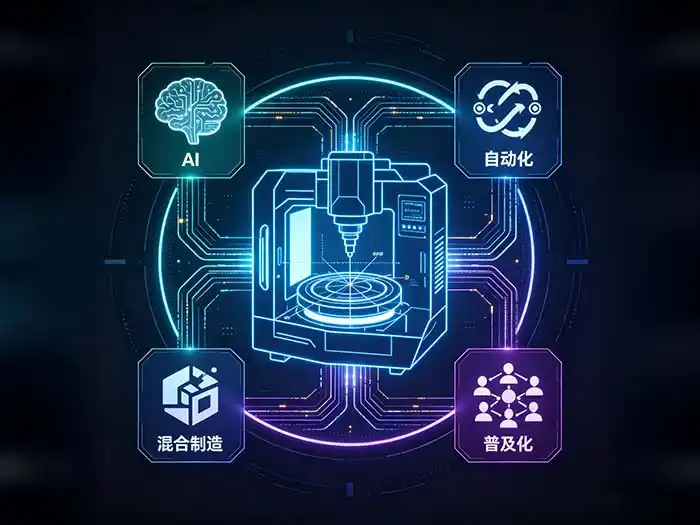
It thinks.
It runs itself.
It does more.
It is more accessible.
The question for shop owners and production managers is no longer “Should we consider five‑axis?” but “Which five‑axis configuration — and at what level of intelligence and automation — fits our part portfolio and growth plans?”
Continue your research with our guide on understanding 5‑axis machine rotations and configurations.
How a 5‑Axis Machine Tool Rotates
5 Mistakes When Buying a CNC Mill
Low Accuracy? Fix Your CNC Mill Setup
3+2 vs. Simultaneous 5‑Axis Machining
Understanding RTCP and Why It Matters for 5‑Axis Programming
This article is part of EUMASEIKI’s technical content library. No direct sales or pricing information is included. All technical discussions aim to help you make informed purchasing decisions.


 English
 中文
中文 Pусский

