When John’s shop landed a contract for turbine housings with deep cavities and angled features, he assumed any 5‑axis mill would do the job. Six months later, his team was fighting constant tool changes, interference issues, and one recurring headache: the machine’s head kept bumping into the part. “We bought a 5‑axis machine, but we never asked how it moves,” he admitted.
That “how” boils down to two dominant architectures: trunnion table and swivel head (often called swivel head/rotary head). Both deliver five axes of simultaneous motion, but their mechanical DNA makes them suitable for very different worlds. If you’re evaluating a new machining center for complex, high‑precision components, understanding this trade‑off can save you from John’s regret.
Let’s cut through the marketing hype and compare these designs across four real‑world dimensions.
Trunnion – The workpiece sits on a cradle that tilts (B‑axis) and rotates (C‑axis). The spindle remains stationary except for XYZ movements. Because the cutting forces go directly into the massive machine frame, trunnion designs excel at heavy roughing in hardened steels and Inconel.
Swivel head – The spindle itself tilts (usually ±90° to ±110°) while the table rotates. This reduces moving mass for the head, but the rotary joints and bearings in the head are less rigid than a fixed spindle. For aggressive material removal, swivel heads often require lighter depths of cut.
Trunnion – The part rotates with the table, so its maximum dimension is limited by the machine’s enclosure. Long shafts or very wide components may hit the door or splash guards. Typical trunnion machines handle parts up to Ø800 mm comfortably.
Swivel head – The workpiece stays stationary (or only rotates on a single axis), while the angled head reaches around it. This allows machining of very long parts (e.g., 2‑meter rail components) or parts that are wider than the table. The downside? The head’s tilt radius eats up Z‑axis travel, and you lose some vertical clearance.
Decision shortcut: If your parts are chunky and fit inside a cube, trunnion wins. If they’re long, tubular, or have weird overhangs, swivel head is your friend.
Trunnion – Because the part tilts, you can access five faces in one clamping. This eliminates multiple setups and dramatically reduces fixture costs. For families of small‑to‑medium prismatic parts (valve bodies, impellers, brackets), a trunnion machine can cut cycle time by 60% compared to 3+2 machining.
Swivel head – Since the head moves rather than the heavy part, acceleration rates can be higher, reducing non‑cut time for tool repositioning. However, the limited tilt angle (often ±90°) means you may still need a second operation for features exactly on the bottom face. Many shops pair swivel heads with a separate rotary table to reach full five‑face capability.
Trunnion – The cradle mechanism adds weight and complexity. Expect a higher initial purchase price (15‑25% more for equivalent work envelopes). Maintenance involves rotary seals, bearings, and braking systems on two axes. But the components are accessible, and many shops rebuild trunnion tables in‑house.
Swivel head – The head’s rotary unit is compact but densely packed with gears, sensors, and cooling lines. When a swivel head fails, repair often requires a factory technician and long downtime. On the other hand, the base machine is simpler and cheaper.
Hidden cost: Swivel heads are more sensitive to coolant ingress and chip packing. Regular cleaning schedules are non‑negotiable.
| Feature | Trunnion Table | Swivel Head |
|---|---|---|
| Best for material | Hard metals, heavy cuts | Soft alloys, finishing |
| Max part size (typical) | Ø800 x 500 mm | 1500 x 600 mm (long) |
| Number of setups for 5 faces | 1 | 1‑2 (may need 2nd op) |
| Rigidity rating | High | Medium |
| Initial cost | Higher | Lower |
| Maintenance complexity | Moderate | High (head unit) |
| Risk of head‑part collision | Low | Medium (large tools) |
If your daily work involves tough alloys, prismatic parts, and you value single‑setup precision – the trunnion architecture is the proven workhorse. It dominates in aerospace structural parts, mold bases, and medical implants.
If you machine long extrusions, large thin‑wall components, or need a lower entry price – a swivel head gives you five‑axis capability with a smaller footprint.
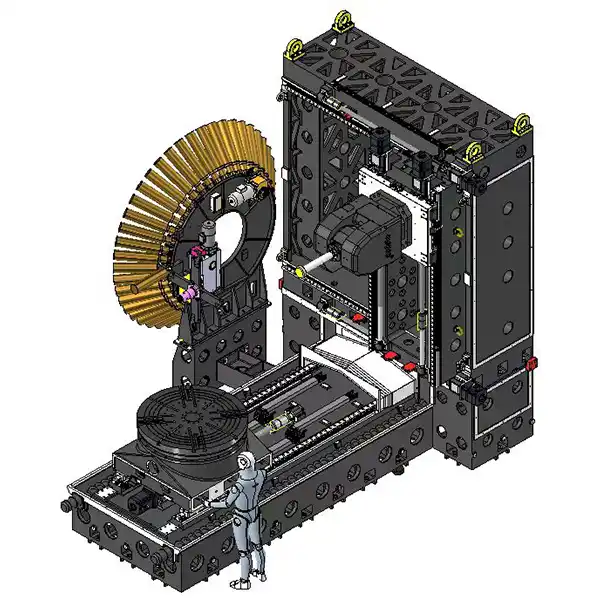
But here’s the nuance that most articles miss: hybrid designs are emerging. Some modern horizontal machining centers combine a rigid trunnion‑like B‑axis in the spindle carrier with a separate rotary table, giving you the best of both worlds. These machines preserve rigidity for heavy cuts while allowing extra‑long parts to pass through.
Interested in how a production‑ready hybrid platform handles both scenarios? Explore modular configurations designed for high‑mix shops.
Even experienced programmers fall into these traps:
Mistake #1 – Ignoring tool clearance
A swivel head with a 100 mm gauge length tool may need 50 mm extra clearance behind the part. Simulate every angle before buying.
Mistake #2 – Overestimating part weight capacity
Trunnion tables have dynamic load limits (often 60% of static). A 400 kg part on a 500 kg rated trunnion can still cause positioning errors during rapid tilting.
Mistake #3 – Forgetting about chip evacuation
Swivel heads that tilt backward can bury chips under the spindle nose. Look for designs with through‑spindle coolant and wash‑down nozzles aimed at the tool tip.
For shops running lights‑out, two additional factors separate winners from losers:
Thermal stability – Trunnion tables have more mass, which acts as a heat sink. Swivel heads with integrated motors may need active cooling to maintain ±2 µm tolerances over long runs.
Probe routines – With a trunnion, you can use the spindle probe to measure features while the part is tilted. On swivel heads, probe calibration must account for head angular errors – a non‑trivial task.
According to ISO 10791‑6 test standards, trunnion machines typically achieve 10‑15% better volumetric accuracy when measured across all five axes. But that gap closes with regular laser calibration.
Neither architecture is universally “better.” The right choice depends on your part mix, materials, and tolerance requirements. Start by listing your top three part families and their worst‑case dimensions. Then run a simple clearance simulation – that will eliminate 80% of unsuitable options.
If you’re still torn, consider a platform that lets you test both configurations on your actual parts. Many builders, including [Brand Name], offer application engineering support before purchase.
For a deep dive into cycle time comparisons using your own CAD models – or to request a test cut – the application team at Eumaseiki provides free feasibility studies. They’ll help you match the right spindle and axis layout to your specific production goals.
Disclaimer: Performance data cited from MTI study (2023) and ISO 10791‑6:2021. Actual results vary by part geometry, tooling, and coolant strategy. Always validate with test cuts.


 English
 中文
中文 Pусский

