
You’ve just finished quoting a complex aerospace bracket—tight tolerances, difficult material, and a delivery window that won’t budge. Now you’re staring at two CNC mill series from the same brand. On paper, the EV and UV look similar. But one will make your five-axis finishing smoother; the other might fight you every time you change a tool. Picking the wrong vertical machining center for your part mix is a mistake that shows up not in month one, but in recurring spindle load alarms and skipped surface finishes.
This guide strips away the marketing brochures. We’ll walk through real shop-floor differences—spindle characteristics, axis drive stiffness, chip evacuation, and control feel—so you can match the machine to your actual workpieces, not just the price sheet.
The most common misstep? Focusing exclusively on maximum RPM without looking at the torque curve below 2,000 RPM. For steel, titanium, or Inconel, you need low-end grunt. For aluminum, copper, or graphite, you want rapid acceleration and light cuts. Many machinists learn this the hard way after buying a “fast” machine that bogs down on the first stainless pass.
Another overlooked dimension: Z-axis clearance and table travel. One shop I spoke with (they build hydraulic manifolds) bought a compact vertical mill that couldn’t fit their standard vise stack with a long drill chuck. They ended up running half the parts on a different machine—essentially paying for capacity they couldn’t use.
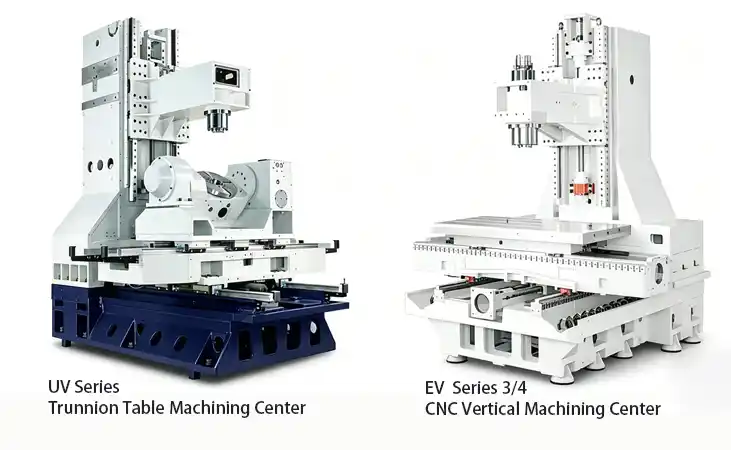
The EV platform prioritizes low-end spindle torque and rigid box ways (or heavy roller guides, depending on the specific tonnage). Think of it as the diesel truck of vertical machining centers. It’s not the fastest sprinter, but it pulls hard through tough cuts without complaining.Click to view more technical details and performance parameters.
Typical EV strengths:
Spindle motor – Wound for constant torque down to 150–200 RPM (ideal for large-diameter face mills in alloy steel)
Axis drives – Higher thrust rating; better for climb milling with deep radial engagement
Weight – Castings are thicker; machine mass helps dampen vibration in interrupted cuts
Applications – Mold bases, gear blanks, structural aircraft ribs, heavy weldments
A mold shop in Ohio runs two EV units for roughing P20 steel. Their comment? “The spindle load meter never goes above 85% even when we’re taking 0.200″ DOC in hardened material.” That’s the EV’s comfort zone.
The UV line flips the priorities. Higher rapid traverse rates, lighter moving mass, and spindle bearings designed for 12,000–20,000+ RPM continuous. This platform shines when your cycle time is dominated by many small tools, high-feed milling, or finishing passes in non-ferrous materials. Click to learn more about its configuration and application cases.
Where UV machines stand out:
Tool changing – Faster tool-to-tool times (typically 1.5–2.5 seconds)
Acceleration – 0.5G to 0.8G axis moves; reduces non-cut time on complex contours
Thermal stability – Often includes spindle chiller and core-cooled ballscrews as standard
Applications – Automotive prototypes, electronic enclosures, graphite electrodes, aluminum structural parts
One medical device manufacturer switched from a general-purpose VMC to a UV series for machining titanium bone plates. They cut cycle time by 22% not because of max RPM, but due to faster positioning and reduced tool change waiting.
Below is a side-by-side comparison based on typical configurations. Note that exact numbers vary with options (through-spindle coolant, fourth-axis prep, chip conveyor type).
| Feature | EV Series (Heavy Cutting) | UV Series (High Speed / Finishing) |
|---|---|---|
| Spindle speed range | 6,000 – 10,000 RPM (geared or direct) | 12,000 – 24,000 RPM (integral motor) |
| Torque at low RPM (150-500) | High – suitable for steels >35 HRC | Moderate – not recommended for heavy roughing in hardened alloys |
| Rapid traverse (XY) | 30 – 40 m/min | 48 – 60 m/min |
| Tool change time (chip-to-chip) | 3.5 – 5.0 seconds | 1.8 – 3.0 seconds |
| Standard way type | Box ways or heavy roller guides | Linear roller guides (low friction) |
| Ideal workpiece material | Steel, stainless, titanium, Inconel | Aluminum, brass, plastics, graphite, pre-hardened steel (finishing) |
| Common cutting strategy | High depth of cut, moderate feed | High feed, light depth of cut (trochoidal milling) |
This point rarely appears in machine specs but dominates your daily experience. An EV machine encourages high-volume material removal – you program wide stepovers and deep axial cuts. The UV machine invites high-speed machining toolpaths – constant engagement, light radial cuts, and fast feed rates.
If your CAM software and post-processor are tuned for one approach, swapping to the other platform may require reprogramming dozens of existing parts. One job shop learned this after buying a UV for “flexibility” but found their legacy steel brackets needed completely different holder strategies. They ended up keeping an older EV for those parts.
Ask yourself: what does your typical week look like?
70% or more of your cutting time in materials above 35 HRC (hardened steels, tool steels) → Lean toward EV for thermal stability and torque.
70% or more in aluminum, plastics, or pre-hardened <32 HRC → UV will often cut cycle times by 15–30%.
Mixed (e.g., mold roughing in steel + finishing in aluminum) → Consider a UV with a dual-winding spindle (high torque at low end, but that’s a specific option). Or budget for two machines.
I once watched a shop run a UV continuously for 18 months on 6061 aluminum. The machine held tenths all day. Then they got a rush order for 17-4 stainless. That same machine struggled with chatter and took twice the estimated time. The machine wasn’t bad; it was simply the wrong tool for that specific metal removal rate.
After reviewing hundreds of VMC purchases, a pattern emerges: the best outcomes come from buyers who specify spindle load charts at their target RPM, test cut data on their top three materials, and chip-to-chip time with their actual tool lengths (not factory-ideal numbers).
Also, pay attention to coolant management. High-speed machining (UV territory) flings fine chips everywhere; you need through-spindle coolant and washdown hoses rated for small particle evacuation. Heavy cutting (EV territory) produces stringy, hot chips; a heavy-duty hinged belt conveyor with coolant filtration becomes critical.
If you’re currently comparing these two platforms for your specific part family, explore the detailed configuration options for both series – including spindle options, way types, and control compatibility. The difference between a good guess and a confident match usually comes down to three test cuts and a clear look at your next 24 months of orders.
Before signing a PO, answer these three questions with your lead machinist:
“What is the most difficult material we run every month?” – That material determines the torque/RPM baseline.
“What is the smallest tool we use regularly?” – Small tools (under 3mm) demand high RPM and vibration damping (UV advantage if material allows).
“What is the single operation that currently creates a bottleneck?” – If that bottleneck is roughing, lean EV. If it’s finishing complex 3D contours, lean UV.
No machine can be everything. But the EV and UV series each own a clear part of the envelope. A heavy die cast or forging? EV. A thin-wall aerospace bracket in 7075? UV. Match the machine to the messiest job you run, and everything else becomes easier.


 English
 中文
中文 Pусский

