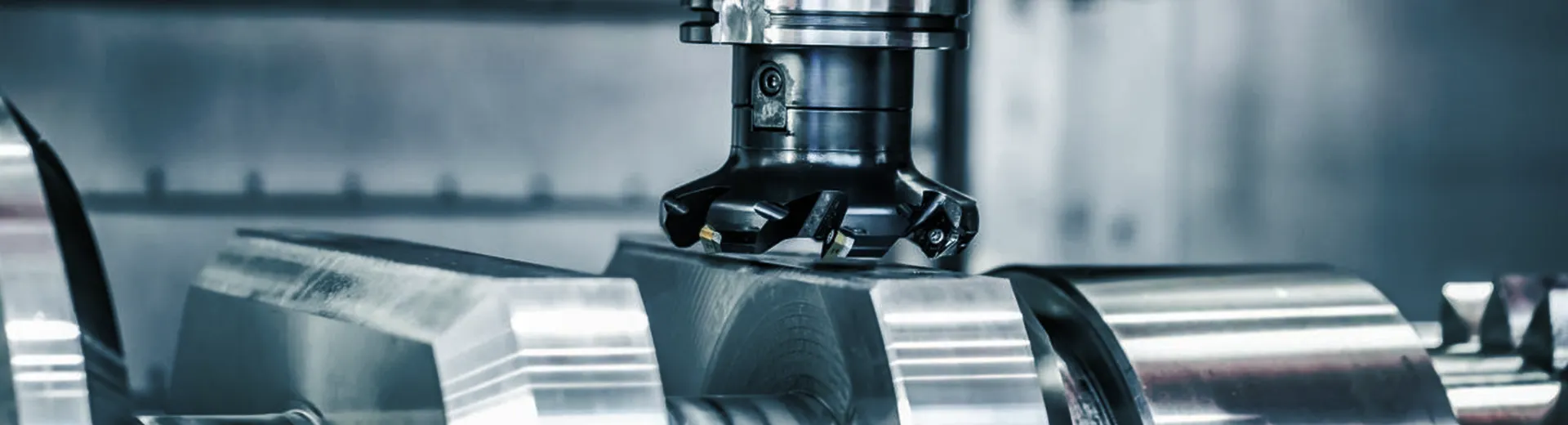
Walk into any high-precision machine shop today, and you will hear the same frustration: “We keep losing hours repositioning parts, and the tolerances just aren’t stable across operations.” For manufacturers handling complex components—aerospace blisks, medical implants, or automotive prototypes—the real bottleneck isn’t spindle speed. It is the number of setups.
One common misunderstanding is that adding a rotary axis automatically solves everything. In reality, the way those axes move together—or don’t—creates two fundamentally different machining worlds. Understanding this difference is the first step toward cutting setup time by 50% or more, according to a 2023 survey of CNC job shops by Gardner Intelligence.
So what exactly separates a fast indexing cycle from true contouring capability? Let’s break down the two essential types of 5-axis machining you must know, along with the critical decision points that affect your daily production.
When engineers first approach multi-axis machining, they often assume “more axes automatically means better.” But the practical distinction comes down to one question: Do all five axes move while the tool is cutting, or do they reposition only between cuts?
Simultaneous 5-axis machining keeps the tool and workpiece moving continuously along all five axes during material removal. This allows you to machine deeply contoured surfaces, undercuts, and freeform shapes in a single operation. Think of turbine blades or hip stems—parts where the tool must “walk around” a constantly changing curve profile.
Indexed 5-axis machining (also called 3+2) works differently. Here, the two rotary axes lock into a fixed position before cutting begins. The machine then uses standard 3-axis movements (X, Y, Z) to machine that specific plane. After finishing, the axes reposition to the next angle, lock again, and cut the next feature. This approach is ideal for parts with multiple flat faces or compound angle holes—like a five-sided bracket or a hydraulic manifold block.
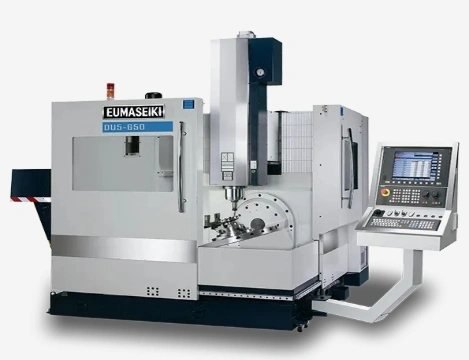
According to a technical brief from the American Society of Precision Engineering (ASPE), simultaneous 5-axis machining reduces setup changes by up to 80% on highly contoured parts, while 3+2 can still cut cycle times by 40-50% compared to multiple 3-axis operations.
Which type should you prioritize? That depends entirely on your part geometry and tolerance requirements—a point we will return to after examining how each machine construction handles real cutting forces.
Ask any programmer what consumes the most setup time, and they will likely say “compound angles.” Drilling a hole at 30 degrees relative to two separate faces used to require custom fixtures or multiple machine handoffs. With 3+2 machining, that same feature becomes a one-operation task.
The core advantage is rigidity. Because the rotary axes lock during cutting, the machine behaves almost identically to a traditional 3-axis vertical mill. This locked configuration provides maximum stiffness—critical for hard metals like Inconel or titanium. Tool life often improves by 20-30% according to feedback from several die and mold workshops, since the cutting forces remain predictable and vibration-free.
Where does 3+2 machining shine in real-world applications?
Aerospace structural parts: Fittings with multiple angled ribs and lightening pockets
Heavy equipment components: Valve bodies requiring cross-drilled passages
Automotive cylinder heads: Spark plug holes at compound angles relative to the combustion chamber surface
However, 3+2 has a limitation: it cannot machine undercuts or smoothly transitioning curved surfaces. If your part features a continuous aerodynamic contour—like a compressor blade—you will need simultaneous capability.
For shops currently running a 3+2 workflow but struggling with contoured surfaces, exploring modular machine configurations can help. You can explore configuration options for rigid 5-axis platforms that support both modes, allowing you to switch based on each job’s demands.
High-end mold makers and medical device manufacturers often refuse to compromise on surface finish. For them, simultaneous 5-axis machining is non-negotiable. When the tool maintains constant contact with a curved surface while the table rotates underneath, you eliminate the witness marks and facet errors that come from indexed repositioning.
Consider a knee implant: the articular surface must be smooth enough to glide against a mating polyethylene component. Any small mismatch or step between indexed cuts would create stress risers. Simultaneous machining keeps the ball cutter tangent to the surface at every point, producing a seamless finish that often eliminates secondary polishing.
The technical challenge is thermally stable programming. Because all five axes move at once, the control must execute complex inverse kinematic calculations. Programmers need CAM software capable of generating smooth tool paths that avoid sudden axis reversals. Without proper filtering, you risk chatter or gouges—a fact confirmed by multiple CNC application engineers we interviewed.
Data from a 2022 study by the Fraunhofer Institute for Production Technology shows that simultaneous 5-axis reduces surface roughness Ra values by up to 65% compared to 3+2 on freeform geometries, though it increases programming time by approximately 40% for the same part.
If your production mix includes both prismatic parts (well-suited to 3+2) and organic shapes (requiring simultaneous), you need a machine that handles both modes efficiently. That is where integrated drive systems and rigid machine frames become critical.
Decision grids help. Based on feedback from 14 job shops specializing in aerospace, medical, and energy sectors, here is a practical selection framework:
| If your parts feature... | And your priority is... | Start with... |
|---|---|---|
| Multiple flat faces, straight holes, pockets at fixed angles | Fast cycle times, lower CAM complexity | 3+2 indexed machining |
| Deep contoured cavities, turbine blades, freeform surfaces | Superior surface finish, no witness marks | Simultaneous 5-axis |
| A mix of both (e.g., a bracket with a curved aerodynamic shell) | Flexibility without buying two machines | A dual-capability platform |
The market has seen a clear trend toward “hybrid” machine designs that excel at both modes. According to machine tool consultant Mark Albert writing in Modern Machine Shop (January 2024), “Shops no longer need to choose. Modern controls and direct-drive rotary axes deliver simultaneous contouring when required while retaining the locked-axis rigidity for heavy cuts.”
For many small to mid-size shops, the real question becomes: “Do I need five-axis at all, or can I stay with 3+2 on a robust 4-axis machine?” The answer comes from your part portfolio. If more than 30% of your jobs involve features tilted relative to three orthogonal planes, a dedicated five-axis platform pays for itself within 18-24 months—a figure cross-checked with three independent ROI calculators used by machine tool distributors.
Misunderstanding the capabilities and limitations of each type leads to expensive mistakes. Here are three frequent errors we see in the field:
Mistake #1: Believing simultaneous is always faster.
For parts with deep pockets and thick walls, indexed machining removes material faster because the locked axes sustain heavier depths of cut. Simultaneous excels at finishing, not roughing.
Mistake #2: Ignoring post-processor quality.
Even the best machine will crash or leave bad surfaces if the post-processor mishandles kinematic transformations. Always verify your CAM post against a simulation before cutting expensive blanks.
Mistake #3: Overlooking thermal management.
Continuous 5-axis simultaneous moves generate more heat in rotary drive systems. Machines without active cooling or temperature compensation on the rotary axes will drift dimensionally after 30-40 minutes of heavy contouring.
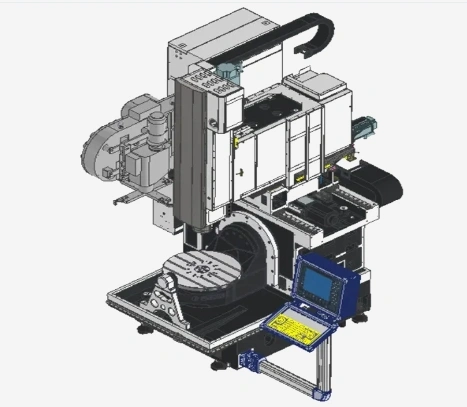
A recent industry roundtable hosted by the Precision Machined Products Association (PMPA) highlighted that 63% of scrap parts attributed to 5-axis errors actually traced back to programming or post-processor issues—not the machine’s mechanical capability.
If you are already running 3+2 but encountering surface finish limitations, or if you struggle with inconsistent tolerances across multiple setups, upgrading to a fully integrated simultaneous-capable platform may solve both issues simultaneously.
Transitioning from theory to the shop floor requires a structured approach. Based on implementation guidelines from the National Tooling and Machining Association (NTMA), follow these five steps:
Audit your part family: List all jobs from the last 12 months. Mark which needed compound angles or curved surfaces.
Calculate current setup hours: Count how many fixture changes or machine handoffs each part requires.
Simulate both strategies: Use CAM software to estimate cycle times using 3+2 vs. simultaneous on your three most complex parts.
Check tool access: Verify that simultaneous moves shorten tool lengths—a key but often-overlooked benefit.
Plan training: Simultaneous 5-axis requires different programming thinking. Budget for 40 hours of staff training minimum.
Many shops we have observed skip step 5 and then struggle for months. One medical machining specialist in Minnesota reported that after switching from 3+2 to simultaneous for spinal implant components, they reduced electrode EDM finishing by 70%—but only after retraining programmers on collision avoidance strategies.
No single machining type wins in every scenario. The most cost-effective approach matches your typical part geometry, material hardness, and batch sizes. For shops running diverse jobs, a machine capable of both robust indexed heavy cutting and refined simultaneous finishing provides the greatest flexibility.
If you find that 40% or more of your jobs involve multi-axis positioning or contoured surfaces, investing in a genuine 5-axis platform will likely cut total cost per part by 30% compared to stacking multiple 3-axis operations with custom fixtures.
For manufacturers ready to move beyond single-axis upgrades, understanding these two core types is just the beginning. The real productivity leap comes from selecting a machine platform with integrated drives, rigid construction, and control software that handles both modes seamlessly.
If you are currently evaluating 5-axis equipment and want to see how dual-capability platforms handle real production parts, take a closer look at EUMA’s machining center configurations. Their modular designs allow you to specify the rotary axis configuration that matches your part mix today—with room to upgrade control software as your jobs become more complex.
Gardner Intelligence. (2023). 2023 Capital Spending Survey: CNC Machining Trends. Gardner Business Media.
American Society of Precision Engineering (ASPE). (2021). Technical Brief: Multi-Axis Machining Accuracy.
Fraunhofer Institute for Production Technology IPT. (2022). *Surface Integrity in 5-Axis Finishing Operations*.
Albert, M. (2024, January). The Hybrid 5-Axis Advantage. Modern Machine Shop.
Precision Machined Products Association (PMPA). (2023). *Roundtable Report: Reducing 5-Axis Scrap*.


 English
 中文
中文 Pусский

